
Teki learning games in 7 areas
Teki's 117 games in seven areas. Every game has three levels, and Teki reads every task aloud.
Quantities, patterns and relations
Your child counts small sets one by one, compares two groups and carries on patterns. The answers are dot pictures, so no digits are needed.
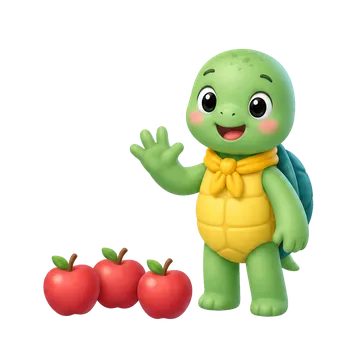
Apples
Your child counts the apples and picks the card with as many dots. If they get stuck, count out loud together.
Little fish
Your child counts the little fish and picks the card with as many dots. If they get stuck, count out loud together.
Building blocks
Your child counts the building blocks and picks the card with as many dots. If they get stuck, count out loud together.
Spoons
Your child counts the spoons and picks the card with as many dots. If they get stuck, count out loud together.
Flowers
Your child counts the flowers and picks the card with as many dots. If they get stuck, count out loud together.
More apples?
Your child shows where there are more apples, or that both are the same. If they get stuck, count the apples together.
25 games, 2 of them free
Same number of ladybirds?
Your child shows where there are more ladybirds, or that both are the same. If they get stuck, count the ladybirds together.
Scattered building blocks
Your child shows where there are more building blocks, or that both are the same. If they get stuck, count the building blocks together.
More pears?
Your child shows where there are more pears, or that both are the same. If they get stuck, count the pears together.
Few flowers, many flowers
Your child shows where there are fewer flowers, or that both are the same. If they get stuck, count the flowers together.
Leaf, flower, ladybird
Your child works out what comes next in the row of leaves, flowers and ladybirds. If they get stuck, say the row out loud together.
Colourful shapes
Your child works out which shape comes next in the row. If they get stuck, say the row out loud together.
Toys in a row
Your child works out which toy comes next in the row. If they get stuck, point along the row together.
Fruit in a row
Your child works out which fruit comes next in the row. If they get stuck, say the row out loud together.
Sun, moon, star
Your child works out what comes next in the row of sun, moon and star. If they get stuck, clap the row together.
Teddy bears
Your child puts the teddy bears in order, smallest to biggest. If they get stuck, find the smallest one together.
Pencils
Your child puts the pencils in order, shortest to longest. If they get stuck, find the shortest one together.
Leaves
Your child puts the leaves in order, smallest to biggest. If they get stuck, find the smallest one together.
Houses
Your child puts the houses in order, smallest to biggest. If they get stuck, find the smallest one together.
Paper boats
Your child puts the paper boats in order, smallest to biggest. If they get stuck, find the smallest one together.
Peekaboo! How many?
A few ladybirds show for a moment, then hide under the blanket. Your child says how many there were.
What's under the blanket?
Teki puts apples under the blanket or takes some out. Your child says how many are under it now.
Fill the basket!
Teki's friends ask for a number of apples. Your child puts exactly that many in the basket and hands it over.
Who's in the third carriage?
Teki drives a train with animals in the carriages. Your child says who sits in the carriage asked for.
Shape hunter
Shapes are hiding in Teki's playground. Your child finds every triangle, circle or square.
Attention, memory and thinking
Your child finds pairs, notices what went missing, sorts things into groups and keeps up when the rule changes.
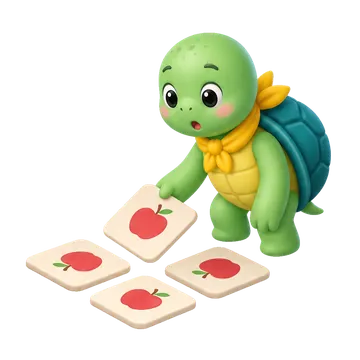
Animal pairs
Your child turns over cards and looks for matching ladybirds, butterflies and snails. If they get stuck, show where the last card was.
Fruit pairs
Your child turns over cards and looks for matching apples, bananas and pears. If they get stuck, show where the last card was.
Toy pairs
Your child turns over cards and looks for matching teddy bears, balls and toy cars. If they get stuck, show where the last card was.
Opposite day
An opposite game: the sun goes to night and the moon goes to day.
Which one doesn't belong?
Odd one out: the child finds the picture that doesn't go with the others.
What's that sound?
Teki plays a sound; the child works out what made it.
29 games, 5 of them free
Clothes in pairs
Your child turns over cards and looks for matching hats, scarves and socks. If they get stuck, show where the last card was.
Garden pairs
Your child turns over cards and looks for matching flowers, leaves and watering cans. If they get stuck, show where the last card was.
What hid from the bag?
Teki covers the things and one hides. Your child picks the one that hid.
Which toy is hiding?
Teki covers the things and one hides. Your child picks the one that hid.
What's gone from the table?
Teki covers the things and one hides. Your child picks the one that hid.
What hid in the garden?
Teki covers the things and one hides. Your child picks the one that hid.
What's gone from the art table?
Teki covers the things and one hides. Your child picks the one that hid.
Toys or clothes?
Your child sorts the toys from the clothes. If they get stuck, ask: do we play with it or wear it?
Fruit or vehicle?
Your child sorts the fruit from the vehicles. If they get stuck, ask: do we eat it or travel in it?
Circle or triangle?
Your child sorts the circles from the triangles. If they get stuck, look for the corners together.
Eating or drawing?
Your child sorts what we eat with from what we draw with. If they get stuck, act out the movement together.
Stripy or spotty?
Your child sorts what is stripy from what is spotty. If they get stuck, look for the stripes together.
Where did the ladybird hide?
Teki shows where the ladybird is, then it hides. Your child remembers the place and finds it; if they get stuck, look again together.
Where did the book hide?
Teki shows where the book is, then it hides. Your child remembers the place and finds it; if they get stuck, look again together.
Where did the leaf hide?
Teki shows where the leaf is, then it hides. Your child remembers the place and finds it; if they get stuck, look again together.
Where's the building block hiding?
Teki shows where the building block is, then it hides. Your child remembers the place and finds it; if they get stuck, look again together.
Where's the yellow star hiding?
Teki shows where the yellow star is, then it hides. Your child remembers the place and finds it; if they get stuck, look again together.
Teki's flowers
Teki's flowers sing one after another. The child taps or names them in the same order.
Yes, please!
Teki is packing for a picnic and asks for a few things. The child hands them over in that order.
New rule!
A postman game. The cards go into the boxes by colour, then by a new rule: by shape.
Butterflies in the meadow
The child finds every yellow butterfly in the meadow and taps each one.
What's different?
Teki drew his room twice; the child finds what is different in the second picture.
What will it become?
The child works out what something becomes, what happened, and at 6–7 reasons from picture pairs.
Speech, vocabulary and stories
Your child picks pictures from spoken words and short descriptions and puts stories in order. Teki reads the picture names aloud, so no reading is needed.
Which one is Teki thinking of?
Your child listens to Teki's riddle and says or shows which one Teki means. If they get stuck, name the pictures together.
What is Teki doing?
Your child hears what is happening to Teki and says or shows what Teki does. If they get stuck, act out the movement together.
Box, glass, cloth
Your child looks for opposites, such as a closed and an open box. If they get stuck, show a real pair at home.
Comb, umbrella, wax crayon
Your child works out what each thing is used for. If they get stuck, show the real one at home.
Who chases whom?
Teki says a sentence and the child finds the matching picture. Sometimes the picture is silly: the mouse chases the cat.
Drum the word!
Teki says a word; the child hits the drum once for every syllable.
13 games, 4 of them free
Ball, box, hat
Your child listens to a short sentence and says or shows what Teki asks about. If they get stuck, say it again slowly.
The flowerpot
Your child puts in order how a seed becomes a flower. If they get stuck, ask what came first.
Teki's drawing
Your child puts in order how Teki draws the house. If they get stuck, ask what came first.
Teki's apple
Your child puts in order how the apple becomes a snack. If they get stuck, ask what came first.
The spilled water
Your child puts in order what happened to the spilled water. If they get stuck, ask what came first.
Teki's postcard
Your child puts in order how the postcard is made. If they get stuck, ask what came first.
What are these all?
Three pictures are shown; the child says what they all are.
Fine motor skills and pre-writing
Your child follows lines and dot trails with a finger, guides Teki through mazes and fits shapes into place. Going off the line is not a mistake.
Raindrop path
Your child's finger leads an object down, across, then along two or three straight lines. Going outside the line is not a mistake.
Connect the dots
Your child joins the dots in order; the blinking dot is always the next one. At the end the picture appears. No numbers are used.
Unscrew the lid
Your child moves a finger round the lid until it comes off; at the second level they close it again, at the third they open three jars one after another.
Snail shell
Your child draws a circle, a circle from two arcs, then a spiral; at the end the snail gets its shell. The direction does not matter, and going outside the line is not a mistake.
Shape into its outline
Your child drags each shape into the outline it fits; at the third level some shapes also need a small turn.
Lead Teki through the maze
Your child leads Teki along the garden path to the lettuce with a finger. First with no fork, then with one dead end, finally through a bigger maze.
12 games, 2 of them free
Wavy stream
Your child guides a little fish along wavy, zigzag and then looping lines to its pond. Going outside the line is not a mistake.
Cross and window
Your child draws the lines of a shape one after another: a cross, a window, then a tent, a slanted cross, a kite and a flag. Each line starts at the green dot.
Shadow match
Your child drags child-safe kitchen and garden tools onto the shadow they match; at the third level some need a turn too.
Copy the sign
Your child copies the sign shown on the board: first over a dashed line, then along start, corner and end dots, finally from the start dot only, at their own size.
Roads to the house
Your child picks the road that reaches the house and leads Teki along it with a finger: between two straight roads, at a fork, finally through a big maze.
Leaf shadows
Your child puts each leaf on the shadow it fits; at the third level the leaves must be turned too.
Movement and body awareness
Your child finds body parts, drums and stops on a signal, keeps the beat with Teki and practises up, down, behind and under.
Body-part finder
Your child finds the body part Teki names on the drawn boy.
What do we use?
Your child picks the body part we use for an action.
Watch Teki!
Teki shows a few moves one after another. The child lays out the cards in that order.
Drum and stop!
Your child drums on one sign and holds back on the other. Practising holding back supports self-control.
Drum with Teki!
Teki plays music and drums. The child hits the big drum on the beat with him.
Where's the ball?
Your child finds the picture with the ball in the named place. This builds the words for places.
11 games, 2 of them free
Teki's route
Your child listens to Teki's route and puts the moves in order.
Where should the ladybird land?
Teki says where the ladybird should land. The child taps there and the ladybird flies to it.
Who stands like Teki?
Teki strikes a pose; the child finds the child who stands the same way.
Slow or fast?
Your child sorts the animals into slow and fast movers.
Hops or crawls?
Your child sorts the animals into hoppers and crawlers.
Independence and everyday routines
Your child puts the steps of hand-washing, tooth-brushing and getting dressed in order, dresses for the weather and packs the bag.
Hand-washing
Your child puts the steps of hand-washing in order.
Toothbrushing
Your child puts the steps of tooth-brushing in order. There is no rinsing: spitting out the foam is enough.
What to wear?
Your child hears what the weather is like and picks the clothes that suit it. You can talk it through at home before going out.
Before and after
Your child hears Teki's plan and picks what it should do before or after.
Can Teki do it alone?
Your child decides which problems Teki can fix alone and which need a grown-up.
Every day or now and then?
Your child sorts foods: what we eat every day, and what only now and then.
14 games, 4 of them free
Getting dressed
Your child puts the clothes in order by what goes underneath. Only orders that are truly fixed count.
Rain or sun
Your child sorts clothes and things by the weather we wear them in.
Tidy-up time
Your child puts toys, clothes and books where they belong.
Safe or stop?
Your child sorts moments into safe ones and ones where we stop. Talk about your own home rules too.
Morning or evening?
Your child sorts daily jobs into morning and evening. Routines differ from family to family.
Pack the bag
Your child decides what goes in the bag and what stays at home. You can try it before you head out.
Look after it
Your child picks what a plant or an animal needs. You can try it with a potted plant at home.
Do we go or do we stop?
Teki stands at the kerb with a grown-up. Your child decides whether they may cross now.
Emotions and social connection
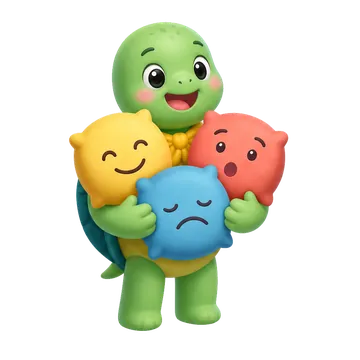
Your child recognises feelings on Süni's face, works out what helps when someone is sad or angry, and solves small friendly situations.
Feeling detective
After a short story your child picks the face that fits how Süni feels. Every feeling is okay; talk about how they would feel.
Feeling pairs
Your child matches the same feeling on two different characters. The feeling makes the pair, not the character.
A good playmate
Your child sorts what makes playing nice or not nice for a friend. Ask what they like when someone plays with them.
Little stories
Your child puts the pictures of a short story about friends in order. Ask them to tell the story.
The tricky box
A box story in pictures. Your child works out who knows what, and what a friend thinks and feels.
Who is happy?
Teki's friends want different things. Your child works out who is happy and who is sad when something happens.
13 games, 3 of them free
What helps when angry?
Your child sorts what helps Süni calm down and what does not. Talk about what helps them when they feel angry.
Which picture?
Your child picks the picture where Süni feels the way Teki says. The face and the situation both help.
What made her feel so?
Your child sorts the moments under Süni's two feelings. Ask whether something like it has happened to them.
A little or very?
Your child orders the pictures of Süni from a small feeling to a big one. Ask how strong their own feelings get.
What does Süni want?
Your child works out what Süni wants, even if they would choose differently.
How can we comfort?
Your child picks what would comfort a sad friend. Talk about what comforts them.
Which sign says it?
Your child picks the hand sign that says what Teki asks.




Your first adventure is waiting
Coming soon to the stores. Until then, try a game from the app right here on the page.


Coming soon to the App Store and Google Play.