For young children, play isn't the opposite of learning; it is one of its most important forms. That's not just what parents see: paediatricians and child development researchers say so too. Here is a summary, and what it means day to day.
What paediatricians say
The American Academy of Pediatrics (AAP) clinical report "The Power of Play" (2018) says that developmentally appropriate play with parents and peers is a singular opportunity to promote social-emotional, cognitive, language and self-regulation skills. These build executive function: steering attention, working memory, flexible thinking. The report also stresses that play helps build the safe, stable and nurturing relationships that children need to thrive.
Back and forth: "serve and return"
According to Harvard University's Center on the Developing Child, when a young child babbles, gestures or asks, and an adult responds with eye contact, words or a hug, this back-and-forth builds and strengthens connections in the child's brain. These connections underpin communication and social skills. What matters is the response: that you notice, and answer.
What turns a game into learning?
A 2017 research review for the LEGO Foundation (Zosh and colleagues) described five characteristics of playful learning:
- joyful – it feels good to be in it;
- meaningful – it connects to what the child already knows;
- actively engaging – the child does it, rather than watches;
- iterative – you can try again and change things;
- socially interactive – with others, talking together.
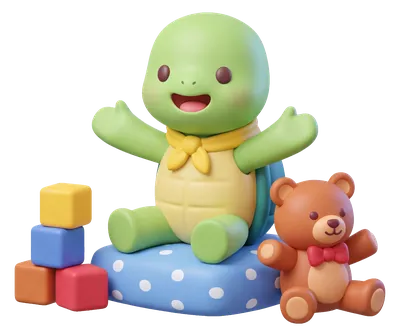
That's a good yardstick at home, too. A block tower you build together, talk about, knock down and build again ticks all five.
A few minutes a day
It needs no programme and no kit. A few ideas:
- Follow their lead. Let your child choose the game and join in.
- Say what they are doing. "You put the red one on top!"
- Ask open questions. "What if…?"
- Stop at the right time. A short, good game is worth more than a long, tired one.
Teki is made for these few minutes: short games, often next to the screen rather than on it, with a turtle who cheers on every try. How Teki works
Sources
- Yogman, M. et al. (2018): The Power of Play: A Pediatric Role in Enhancing Development in Young Children – AAP, Pediatrics 142(3) (read 24 September 2026)
- Serve and Return – Center on the Developing Child, Harvard University (read 24 September 2026)
- Zosh, J. M. et al. (2017): Learning through play: a review of the evidence – LEGO Foundation (read 24 September 2026)